Friday, April 22, 2022
Maldives 2022 Blog Post
For 10 days of Spring Break, we traveled to the Maldives where my dad and I would get our PADI Open Water Diver Certificate. We first flew from Dammam to Dubai, a quick one-hour flight. After a simple layover in Dubai, we took a four-hour flight to Malé, the Capital of the Maldives. The Malé airport is really small, and it was confusing to navigate. Once we were greeted by a representative of The Mövenpick, the resort we were staying at, we stayed in the VIP lounge for about an hour, waiting for our float plane ride to Kuredhivaru, the Island in the Noonu Atoll we were staying at. When our float plane arrived, I was eager to sit in the front so I could look at the controls because I want to be a pilot some day. When the plane was taking off, I freaked out because the plane was shaking like it would fall apart. It was about a 45-minute ride, and I just looked out the window and tried to memorize some of the controls in the cockpit. The landing was less scary, and I noticed what the pilots did on landing, taking in the controls and how they maneuvered the plane.
When we got off the plane, we were greeted by our “Island host” Youcef, who kindly showed us around the resort on a buggy, and told us about the restaurants and what was included. When we got to our villa, not over water but on land, there was really nice furniture and it was spacious and luxurious. We had our own mini infinity pool and a walkway down to the beach. The view was incredible, we were able to see several other islands and the water color was turquoise, just like in an island paradise. Later, we visited the Dive Center where we met Alex, our Dive instructor. On our second full day there, we visited the dive shop again and Alex showed us all of the gear and reminded us on how to use it. We already learned from the E-Learning phase. For our first Open Water Dive, we did a DSD, or Discover Scuba Diving in front of the Dive Center. I wanted to see a turtle, and on my first ever dive I did! (More on my luck later.) After the dive, Alex showed us how to disassemble our equipment and clean it. Later, after we ate we went snorkeling some more, and we saw a Blue-Fin Jack which is shown below, a large Blacktip Reef Shark and some parrotfish.
The next morning, we met Alex at the Reception. There Alex briefed us on the dive, it would be our first of five training dives. We combined some of the skills from the other training dives into this dive, such as regulator recovery and clearing, partial and full mask clearing, neutral buoyancy, and the Alternate Air Source Ascent. Before we entered the water, Alex taught us the acronym for the safety check. Blue Whales Are Really Fat. Blue stands for BCD, so check if the dumps and the inflator/deflator works. Whales stand for weights, so make sure your weights are tight and correctly positioned. Are stands for air, so smell your air and check both purge buttons, on your regulator and on your octopus. Make sure that when you breathe through your regulator, the needle on the SPG does not move, if it does that means your tank isn’t opened all the way. Really stands for releases, which includes the release on your tank. Have a buddy help you make sure it is secure by trying to move it around in its strap. Fat stands for final, which is fins, mask, snorkel, dive computer, and compass. When you are about to descend, the acronym is SORTED, which stands for signal, orientation, regulator is in your mouth, time, elevate, descend. After we descended, we started practicing the skills Alex briefed us on. Pictured below is a Dash-and-Dot Goatfish.
For the regulator recovery, the regulator is the piece we breathe from. For this skill, it would be used for example if your regulator fell out of your mouth if you see something amazing and accidentally open your mouth. The regulator recovery skill is quite simple. Bring your right arm all the way back staying close to your side, and then bring your arm in a wide sweep back around to the front of your body. Make sure to make little bubbles the entire time the regulator is out of your mouth, in case you rise a bit and the air in your lungs expands, which could cause paralysis and death. The other part of the skill is regulator clearing, like if your regulator is plugged or right after a regulator recovery there is water in it. Simply press the purge button, the button on the front of the regulator, or just blow through the regulator.
Another skill is partial and full mask clearing, if your mask is foggy or full of water. Simply tilt your head upwards, and blow through your nose while lifting the bottom of the mask a tiny bit and pressing the top of your mask. For full mask clearing, do the same. You may have to clear the mask several times before all of the water is out. If your mask is foggy, just lift the bottom of your mask and let some water in. Then move your head around so the water goes throughout your mask. Then just clear the mask. Remember, you will always have a little bit of water at the bottom of your mask.
For neutral buoyancy, try to find a flat and sandy bottom if you can. Empty your BCD, and let yourself sink to the bottom. Slowly breathe in, and out. When you breathe in, and barely move up, inflate your BCD a little. Keep repeating this until you rise fully when you breathe in, and then drop back down when you breathe out. As soon as you reach your planned depth, immediately establish neutral buoyancy. Neutral buoyancy could help you rise over a big rock or coral, and just breathe in and glide over it.
The last skill is the Alternate Air Source Ascent. In case you or your buddy runs out of air, your buddy would share their air with you by giving you their octopus. First you signal out of air to your buddy, and then signal share air. Once your buddy gives you their octopus, form a “Roman Handshake” by gripping their right forearm with your right hand. Then slowly ascend using STELLA, the acronym for signal, time, elevate, look, listen, and ascend.
Later that day after lunch, we met Alex at the Dive Center. Once we got on the Dive Boat “Aroma,” Alex briefed us on the island we would be diving at, called Dheefuram. Once we got to Dheefuram, we put on our gear and fins, and then used the giant stride entry technique. Just hold your weight belt with your left hand, and hold your mask and regulator on your face with your right hand. Look straight ahead and take a long step and let yourself fall into the water. Once we descended, we instantly saw hundreds of fish. We were swimming along and then I saw this really cool fish in the coral, called a Regal Angelfish, which is pictured below. As we were reaching our max depth, Alex banged on our tanks and pointed above us, a Spotted-Eagle Ray was gliding over us. I have a stuffed Spotted-Eagle Ray named Spotty, and so I was very excited to see the Eagle Ray. When we swam along the reef wall, we saw some clownfish, and one kept swimming right in front of my mask, and then when I breathed out of my regulator, bubbles came out and the clownfish darted back into its anemone. When we surfaced, we practiced SMB inflation, where we inflate the Signal Marker Buoy with our Octopus. When we got back to the Dive Center, we disassembled our equipment and washed it. Then we planned when and where our next dive would be, and then went snorkeling.
The next morning, we again met Alex at the Reception, and then he briefed us at the Welcome Jetty, where the float planes land. We assembled our equipment, and then entered the water using the seated entry method. We practiced a few more skills and reviewed some, such as the tired diver tow, where you grab the diver by the nozzle of the tank and bring the diver next to you and kick. This is used on the surface only.
The next day, we rode on the Aroma to our next dive site, Uthuru Maa Haa. Uthuru maa haa is an underwater island that is rising, not sinking. The current was very strong, and we had to submerge immediately. We had to hang onto a rope the Aroma threw down and had to grip as tight as possible or be sucked away from the boat as it sped back to Uthuru Maa Haa. Once we got to the dive site, we had to submerge immediately, but my ear kept squeezing and I couldn't equalize. Alex just kept pulling me down, and suddenly it stopped hurting. After we reached the max depth, we started swimming around. I was swimming and suddenly I stopped. There was a Giant Moray Eel hiding among the coral, and It was huge! It’s head was larger than mine, and it was at least 4-5 ft long, and we didn’t see most of it because it was hiding in the coral. We also saw a lion fish really close to us with its spines out, which was pretty cool. First Alex had me swim with my compass in a certain direction, and then again back to the starting point. After I succeeded, it was my dad’s turn. He made it all the way to the turning point, and then used his arm to turn around again, which you are not allowed to do. We continued swimming, and then did our safety stop, 3 minutes at 5 meters. After we surfaced, we inflated the SMB and soon the Aroma came chugging over to us. Once we boarded the aroma, Alex told Dad why he failed the compass activity. To me, Alex said “ congratulations, you are now a certified Open Water Scuba Diver.” Now that we are certified, we don't have to disassemble our equipment. After we took off our fins, we planned where and when we would meet tomorrow.
Our dive the next day would be a fun dive, at Christmas Rock. To me, it looked like a pile of pancakes, larger at the bottom and smaller at the top. After we submerged, I knew that my ears were going to hurt. I gave the signal to stay level, and Alex agreed. I kept sinking a little and I realized my ears had stopped hurting. As we were swimming across the bottom from the wall to the rock, we saw a Spotted-Eagle Ray far below us gliding along the bottom. As we neared the rock, we saw divers below us. We were at the maximum diving depth for Open Water divers, and their tanks had the NITROX label on them. so either they were breaking the law or they were specialty divers. As we neared the rock, I saw five lionfish spread out in the dead coral, they were pure black with bioluminescent white spots along their sides and white spines with black dots, a variation of Common Lionfish. As we circled the rock, we spotted a stingray hidden beneath the sand below us. We continued around the rock but we didn’t see much more, so we started our ascent, and then completed our safety stop. When we surfaced, we signaled the Aroma and soon we were back on board, with Mom and Sister soon joining us from snorkeling above us. They saw a rare Mobular Ray while snorkeling, which is cool.
Alex and Amanda, the other dive instructor who was diving with Mario, another diver with us, discussed where we should dive next. We headed back to the resort, but this time near the over-water villas, close to the welcome jetty. We hoped to see Giant Guitarfish, but unfortunately we didn’t.
Once we jumped in, I realized the visibility was average, not as great as the other places probably because of the boats and all of the floatplanes. We submerged, and we saw a clownfish in its anemone. As we swam along, I twisted my head back to look for guitarfish and gasped. I got Alex's attention, and he banged on our tanks. We stopped, and looked at the White-Tipped Reef Shark slowly circling us, for a few minutes. After it left, we signaled the OK sign and continued swimming. Because the Guitarfish are deep, we accidentally exceeded the limit and dove down to 22 meters, where the max is 20. As we were swimming, my knee brushed against an anemone. I turned and saw a Powder-blue Surgeonfish next to the parrot fish, pictured above. We ascended, and did our safety stop. When we surfaced, I told Alex about my knee, and he said to not worry, it just brushed up against it. When we boarded the Aroma, Alex just wiped it with a cloth soaked in a medicine, and he said try not to bump it up against anything. When we got back to the dive center, Alex took my picture and then my dad’s for our scuba certificates. We said thank you and goodbye to Alex. He showed us how to access our certificates on the PADI app, which was cool. and Then we left. Unfortunately, we couldn’t dive anymore because we had to wait 24-hrs before we flew, and the next day our flight was leaving. Once we got on the float plane, I sat right behind the pilots again because I would like to be a pilot someday.
Thanks for reading my blog post on our trip in the Maldives!
Thursday, February 17, 2022
Mangrove Eco Park Blog Post
When the opening of the Mangrove Eco Park was announced, I knew I had to go and bring my new camera. It was about a 25-minute drive to the park, and the guides there had told us to come at high-tide, and we wondered why. When we got to the park, there were millions of mangrove trees planted in the water. As we walked out on the boardwalk, we didn’t see any birds, but the water was pretty. As we reached the end of the boardwalk, I scanned with the scope first but only saw 5 or 6 Greater Flamingos, which is not what they said we would see. On several different signs, it showed many different shorebirds, but the water level looked low in those pictures. When we got back to the main building, we asked a guide why they wanted us to come at high tide. The reason why, apparently, was because it was prettier. Wanting to see more birds, I asked when the best time would be to watch birds, and the guide said at medium tide, in between low and high tides. The next weekend, we came back about halfway between the two tides, and started scanning for birds. Without good equipment, you wouldn’t be able to see any of them.
Whiskered Tern that kept swooping and diving near us
We first saw little Terek Sandpipers running, then stopping, running then stopping in the sand, occasionally poking their long bills in the sand, sifting for sand fleas and other tiny creatures. After scanning a bit more, we found a sandbar with two huge gulls and several Dunlins and other sandpipers. Because the Dunlins were so far away, it was hard to get a good shot, even with a high-tech camera and lens, but there was a Pied Oystercatcher, AKA Eurasian Oystercatcher on the sandbar, digging in the sand like the curlews. A funny, but not too unusual sight was 8 Gray Herons huddled up against the wind near a mangrove, because it was too windy for them to hunt.
Besides the herons, there were some little sandpipers and some flamingos out in the water on a sandbar, but it was impossible to get a close-up picture without it being super grainy. That was pretty much it, though that was many birds compared to the first time we came, where we saw only flamingos. The landscape was flat, and at low tide it was mostly mud, and behind us past the water were mangrove trees until they stopped and became the desert. In front was water and sand speckled with sandpipers and other waders and a few mangroves.
As of the writing of this post, It is the first day of the Great Backyard Bird Count, and I want to go to the Mangrove Eco Park again by the 21st, so if we see the same birds and new species, the data can be a part of the GBBC data. For more pictures and captions, check out my new section on my website for the Mangrove Eco Park, once I get a few more pictures.
Friday, January 14, 2022
Padilla Bay Christmas Bird Count
The first Audubon Christmas Bird Count was in 1900. Twenty seven birders counted at 25 different points and recorded a total of about 90 bird species and is now continued annually. I participated this year with my mom, my grandfather, and Elizabeth “Libby” Mills, an ornithologist on January 5, 2022. We drove to Samish Island, in Washington State and stopped in three different places, Scott’s Point, where we saw two merlins and an American Kestrel chasing a Bald Eagle. The second stop we birded at was Camp Kirby, where we saw two Black Brant coming on to shore to eat pebbles and a Belted Kingfisher, the only one for the day. Our third and final stop was at Samish Island Public Beach Access, where we saw a Horned Grebe and hundreds of buffleheads.
We started at Scott’s Point, just at the entrance to Samish Island. Instantly we were already behind in recording all of the birds. There were a plethora of Bald Eagles, both immature and adult. As we were observing an Immature Bald Eagle, I spotted two Merlins and an American Kestrel chasing after an Adult Bald Eagle. Libby Mills was excited, because it is unusual to see a Kestrel and two Merlins in the same tree within 5 feet of each other. There was a strange sight, because in a bush was either a wing or all of the body except the head of a medium sized bird. Libby suspects that the merlins killed the bird, because falcons, and merlins usually take a nip out of the shoulder of the bird they just killed. The Merlins and the Kestrel were by far the best sighting we had of the day. On our way to the car, 20 or so unidentified ducks flew over our heads. We also saw a Bald Eagle carrying nesting material. There is also a rookery nearby that the Eagles use.
Above: The American Kestrel near the Merlins.
Our next stop was at Camp Kirby, about five minutes away from Scott’s Point, where we had kindly been granted permission to bird at the camp down at the beach. We were scanning the water for buffleheads and mergansers, and other seabirds when I spotted a belted kingfisher land on a branch above the water. As we continued to walk around the point, we noticed some rose bushes with holes in the place where the flower was. As Libby explained that the holes were made by wasps so the larvae could eat the rose, a Downy Woodpecker landed on one of the dead roses with wasps in it and began pecking away at it, trying to find some larvae for lunch. Another exciting event was when two Black Brant came ashore to eat pebbles to help digest the Eel Grass they eat. An uncommon little shorebird also appeared behind the Double-Crested Cormorants, Glaucous-Winged Gulls and Black Brant, 20 Black Turnstones!
Above: The Downy Woodpecker on the Rose Bush.
Even though it is called Samish Island Public Beach Access, we didn’t go down to the beach, we stayed at the top where we had a better vantage point. As we were scanning the water, I came across a flotilla of buffleheads. There were at least 75, and mixed in were Common and Red-Breasted Mergansers with Common Loons and a Horned Grebe. Scopes were very important because even with a high powered camera with 600-mm zoom, the seabirds still looked like tiny black dots. By this time, our hands and feet were icicles, so we scanned for a few more minutes and then called it quits. Libby stayed a few minutes longer and saw a Hooded Merganser, a Eurasian Collared Dove, and a Pacific Wren, the only one of the day.
Above: A Common Goldeneye we observed from the top of Samish Island Public Beach Access.
To be honest, this was probably the most birds I have ever seen and counted at one time, which is saying something. I saw 10 new bird species, including Horned Grebe, Double-Crested Cormorant, and Black Turnstones. In total, we saw 45 species of birds and a Grand total of 579 individual birds across Samish Island. It was mostly seabirds, because 167 of them were buffleheads! I will have other blog posts coming soon about other bird counts and other affairs concerning birds.
Saturday, October 9, 2021
October Big Day 2021
What is October Big Day? October Big Day celebrates World Migratory Bird Day. October Big Day started on October 17,2020 and is now an important day for bird conservationists because it helps determine where birds migrate and what their preferred habitat is. Last year, in 2020, 7,125 species were recorded. Worldwide, 7,287 species were counted this year. This year, 193 countries participated.
We started our day before 6 A.M, (pictured above) at the golf course because we knew that it is where we would see the most birds. It is along the beach and it has a variety of different habitats, including a canal that weaves all through the golf course. When we drove in the golf cart to the golf course in the morning, we beat all of the golfers. Usually, we have to dodge golfers when we go. The weather was cool, windy, and also humid.
At the golf course, we saw a Black Eared Kite which happened to be the only one observed in Saudi that day, a Common Kingfisher at the canal,(pictured below,) and a European Bee Eater.
We also visited the nearby Ras Tanura Corniche, where we observed an abnormally large Eurasian Curlew, (pictured below,) and a Eurasian Hoopoe in the grass. When we were driving down the road leaving the corniche, we spotted six Spotted Flycatchers, two more Red Tailed Shrikes, and five Crested Larks on the barbed wire fence overlooking a scrub area. Another place we visited was the desert area behind the beach.A few interesting birds we spotted were a Greater Hoopoe Lark, yes, an actual one this time, a Juvenile Namaqua Dove, and two Spotted Flycatchers. We cooled off at the beach, but we only saw a gigantic tern of an unknown species, a Cormorant, and two Caspian Terns.
When we see a bird, unless it is a common bird around R.T, we need to identify it carefully. An important skill to know is how to identify certain birds with help from a bird book. Look at the size for a general knowledge for the group of birds. For an example, we looked at the size of the bird, which is 19-23 cm. Then we looked at shape of bill. It is long and slightly curved at the end.Then we looked at feet. Three in the front and one in the back. Finally, we looked at the color of the bird, mostly brown with a bit of white. This description matches the description of a Greater Hoopoe lark, but unfortunately we now believe it is an Isabelline Wheatear, similar in size and color, but it’s legs are skinnier and it’s bill is not as long or curved. We thought we saw a hoopoe lark at the golf course in the morning, but it turns out it was an Isabelline Wheatear.
Stay tuned for more pictures and captions on my website soon!
Friday, August 20, 2021
Catching and counting butterflies on Sauk Mountain
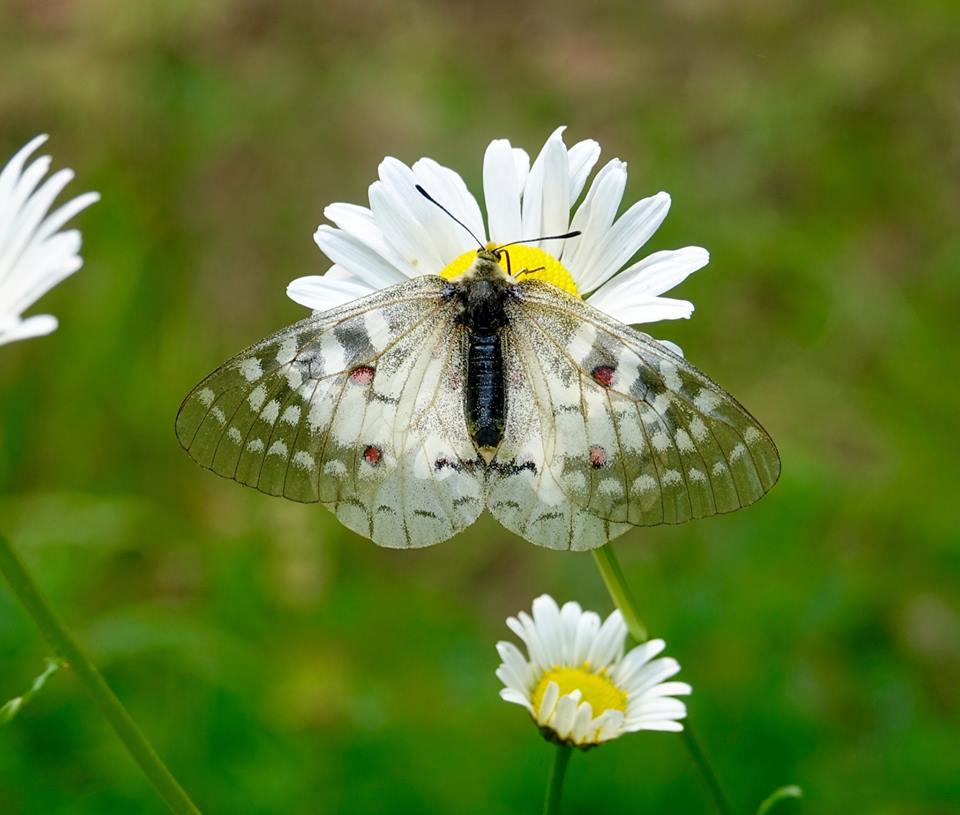
I first got interested in butterflies when we first climbed Sauk Mountain two weeks ago. We were hiking and we took a break, and behind us we saw these people with butterfly nets. I am naturally interested in anything to do with insects, and when I saw the butterfly nets, I couldn't stop wondering about it. We waited for a few minutes before they caught up to us, and it turned out they were volunteers for the National Park's Cascade Butterfly Project. I observed them for the rest of the time, and the observer, Adriana, gave us her phone number to contact her. She let me borrow her net, and I caught my first butterfly, a Clodius Parnassian, (Parnassius Clodius), pictured below, that same day.
A week later, we got off to a bit of a late start to Sauk Mountain again, but it turned out Adriana and her family had as well. I soon caught up to them and we immediately started counting butterflies. The first butterfly we caught was an Anna's Blue, one of the most common butterflies in the cascades. In total we caught 56 Anna's Blues. We caught more blue's, such as one rare arctic blue, a Boisduval's blue, and observed 8 unidentified blues. The total amount of blues we caught was 68. We caught a few copper's, such as 2 Mariposa coppers, 13 purplish coppers, and 8 unidentified coppers. The coppers are relatively small, about the size of a nickel. The total amount of coppers we caught were 23. We took a quick break, and then continued counting butterflies.
There were lots of fritillaries, the little orange ones with the silvery spots on the ventral, (outside) part of their wings. We saw 47 unidentified Fritillaries, 4 Hydaspe Frits, and 17 Mormon Fritillaries, the one pictured above. We saw only a few parnassians, 4 unidentified and 3 Clodius Parnassians. We had also seen 14 unidentified butterflies. In total, we counted 178 individual living butterflies! We hope to see more butterflies again soon when we leave Saudi, but for now, Please stay tuned for more information on my website, www.birdsandturtles.com, for more info about my adventures.
Sunday, January 10, 2021
January 2nd - Seven Island Bird Sanctuary
The drive to Seven Island Bird Sanctuary was about 45 minutes, and on the way, we saw a falcon of some kind, possibly a Peregrine Falcon or a Merlin. As we were driving down the road in the park to the parking lot, my mom said that a good place to see birds was down by the boat launch, and that not many other birders use it. As we pulled up to the boat launch, the first thing we heard were two Carolina Wrens calling each other. As we got out of the car, I saw one of the Carolina Wrens and a Northern Mockingbird. As we started down the trail, we heard and saw hundreds of birds flying across the trail. We saw two Pileated Woodpecker houses on two trees. Then, we heard a Pileated Woodpecker calling and then we saw it climbing up a tree! I am always excited to see Pileated Woodpeckers, but in 2020 was amazing! The only other time I can remember when we saw a Pileated Woodpecker was in Florida. I couldn’t get a picture because he was too hidden in the branches. We saw three or four Eastern Towhees hopping in the branches. The trail was filthy with Cardinals and Robins. We spotted two groups of five or six deer hopping around to go down to the river to get a drink. We heard what we thought was a Carolina Chickadee, but when we got to another trail, we realized it was a White Throated Sparrow. We also spotted some American Goldfinches.
After we finished the boat launch trail, we headed back to the car and had a snack. As we were eating, we saw a Northern Mockingbird on a fence post near us, eyeing our kettle corn. He must have been fed by other people having a snack. After we finished, we walked down a road but there were people everywhere. We eventually found a small trail that nobody was walking on. We walked up a long hill, and at the top we found a bush with a northern mockingbird in it, posing for us. The scenery was small bushes, and as we were walking we saw five or six White Tailed Deer hopping through the bushes. At the top, my sister and I ran down a long hill, and at the bottom there was a small pond. On the pond was a small boardwalk and viewing platform. The platform was made out of around 170,000 recycled plastic jugs. We saw one female and two male Northern Cardinals in a bush. As soon as they were startled, a Marsh Wren flew in and took their spot. We also saw three White Throated Sparrows hopping around.
| The Northern Mockingbird eyeing or kettle corn. |
| A Cedar Waxwing by our house in Sevierville |
| A Golden Crowned Kinglet at the boat launch trail. |
January 3-6 Ellijay Georgia Property
We arrived the evening of the third at our next airbnb in the mountains of North Georgia. The first thing we noticed was all of the land that was part of the property. The house was huge. After we explored the house, we went on a walk around the property. The next morning, after my mom got the groceries, we went walking again and this time, there were cattle out on the farm across the stream! My sister and I found some grass for them, but they weren’t interested in us. When we came back, I noticed that there were at least ten Eastern Bluebirds in the bushes! We had basically won the “Bluebird Lottery.” I also spotted some Northern Cardinals and an Eastern Phoebe on the hot tub cover! We also saw twelve Turkey Vultures circling above our house. We constantly heard Carolina Wrens in our yard, and also heard a White Throated Sparrow responding to my calls.
| A bright Eastern Bluebird escaping us. |
| Notice the bold bright blue on this Eastern Bluebird. |
| This guy was ten feet from me on the deck! |
Bombay Hook, Deleware
Bombay Hook is only 10-15 minutes away from the house we are staying in, so we were happy about that. As we pulled into the parking lot, the first thing we noticed was we had to pay a fee, but we didn’t know that we had to put the money in an envelope. We had put twenty dollars straight into the box, and then we realized that we had to put it into an envelope provided first, so we put another twenty dollars in. After we left the parking lot, we drove down a gravel road, and after a thousand or so feet, we drove around a corner and passed a small man-made “pool” called Raymond Pool, and then we drove past another man-made “pool” called Shearness Pool. We saw literally thousands of Snow Geese, and every time we looked up we saw lots of V’s, with hundreds of Snow Geese in each V. This morning, before we went birding, we went jogging down to Shearness Pool and back. It was 27o, and it actually felt good on my burning cheeks. Later tonight, as we were driving to Fowler Beach to see owls, we saw lots of what looked like snow, but then we realized that it was thousands of Snow Geese on the grass, hunkering down for the night. Every time we looked up, there were lots of V’s. We saw 3 or 4 Northern Harriers flying around, we might have seen one owl flying, but we aren’t sure. Besides the thousands of Snow Geese, we were also able to add several new species to our E-bird life list, including the Carolina Chickadee, Golden Crowned Kinglet, Snow Goose, Green Winged Teal, Northern Mockingbird, Northern Harrier, Turkey Vulture and more.
This Snow Goose was trying to catch up with the rest of the flock.
Subscribe to:
Posts (Atom)